
Journal/November 2025 · 5 min
IPL vs Laser Hair Removal: What's the Difference?
IPL and laser hair removal are marketed interchangeably but use different technology. Here's how to know which one is right for your skin and hair.
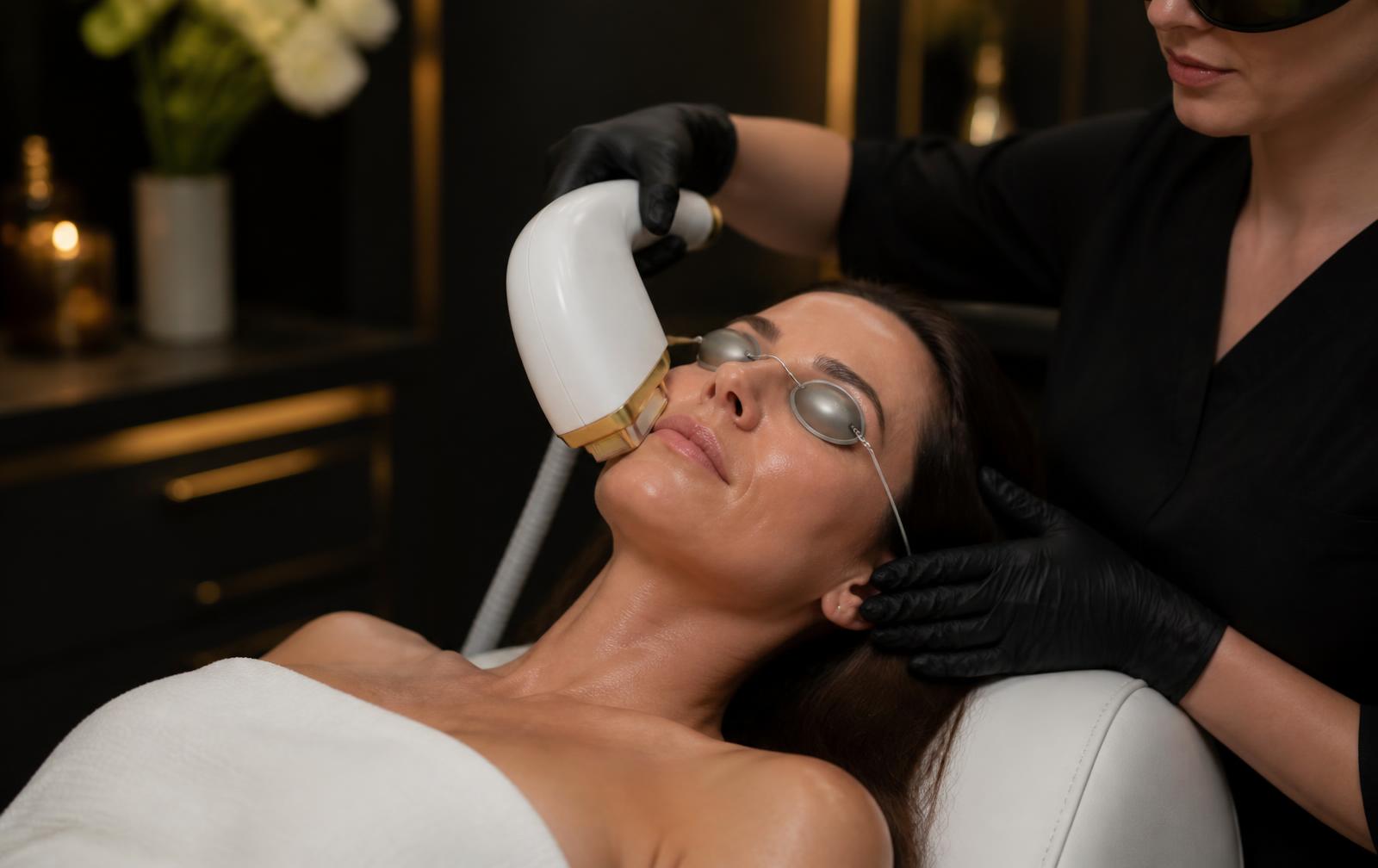
IPL and laser hair removal are often marketed as if they were the same treatment. They aren't. Both use light energy to target hair follicles, but they use it differently — and the difference matters for anyone with darker skin, coarse hair, or specific body areas in mind. Here's what actually separates the two technologies and how to choose between them.
Looking for the treatment itself? See our Laser Hair Removal in San Antonio — IPL at THEIA page for pricing guidance, protocol details and booking.
The core technical difference
IPL — Intense Pulsed Light — emits a broad spectrum of wavelengths in each pulse, filtered to target melanin in the hair follicle. Because the light is diffuse, IPL covers larger surface areas quickly and treats a range of pigmentation issues alongside hair.
A true laser emits a single, concentrated wavelength. Diode (around 800nm), alexandrite (755nm), and Nd:YAG (1064nm) are the three most common wavelengths for hair removal. Because the light is focused, lasers can target deeper follicles and, in the case of Nd:YAG, safely bypass surface pigment on darker skin.
Which technology fits which skin and hair
IPL performs best on light-to-medium skin (Fitzpatrick I–III) with dark, coarse hair. It's fast, effective, and comfortable for those patients. It struggles with very light or blonde hair (not enough pigment to absorb the light) and can be unsafe on darker skin tones (too much surface melanin to safely deliver energy).
Nd:YAG laser is the standard for Fitzpatrick IV–VI skin — its longer wavelength penetrates past the surface pigment. Alexandrite is very effective on Fitzpatrick I–III with fine-to-medium hair. Diode falls in between and is versatile across many skin types.
Related at THEIA: CO₂ Laser in San Antonio — Pigmentation & Resurfacing at THEIA · Microneedling in San Antonio — Dermapen at THEIA.
Speed, comfort, and session count
For large areas like legs or back, IPL and diode lasers cover ground quickly — a full-leg session can be done in 30 to 45 minutes. Smaller precision areas (upper lip, bikini line) are similar across both.
Session counts are roughly the same: 6 to 8 spaced 4 to 6 weeks apart. Comfort depends more on the machine's cooling system and the operator's technique than on IPL vs laser.
Cost
Across San Antonio in 2025, IPL and laser hair removal are priced similarly at reputable clinics. What varies is the value: a provider using the right technology for your skin type will get you to full reduction in fewer sessions, so the total cost is lower even if the per-session rate looks identical.
If a clinic offers only IPL and you have darker skin, the safer answer is to find a provider with Nd:YAG capability — not to accept whatever machine they have and hope for the best.
How to choose in San Antonio
Ask three questions at your consultation. First: which specific technology will be used on my treatment areas, and why is it the right fit for my skin and hair? Second: who is the certified operator? (TDLR certification is required for laser and IPL in Texas.) Third: what does the treatment plan look like if my hair or skin doesn't respond as expected?
At THEIA, IPL is our primary hair-removal modality and is a strong fit for most patients — but consultations always start with a skin-and-hair assessment so we can confirm the safest, most effective protocol for you.
Questions
Frequently asked.
Is IPL considered laser hair removal?
Colloquially yes, but technically no. IPL uses broad-spectrum pulsed light; true laser uses a single wavelength. Both are effective when matched to the right patient.
Which is better for the face?
For light-to-medium skin with dark facial hair, IPL is excellent. For darker skin tones, Nd:YAG laser is safer. Ask your provider which machine they'll use before booking.
Can I mix IPL and laser sessions?
Some clinics do this deliberately. It's not standard, and consistency (same machine, same operator) generally produces the most predictable results.
Continue reading
More from the journal.
Begin with a consultation.
Every treatment at THEIA begins with a medical consultation and good faith examination.