
Journal/January 2026 · 6 min
PRP vs Microneedling — Which Treatment Do You Actually Need?
What each treatment does on its own, what changes when they are combined, and how to choose based on your specific concern rather than the menu name.
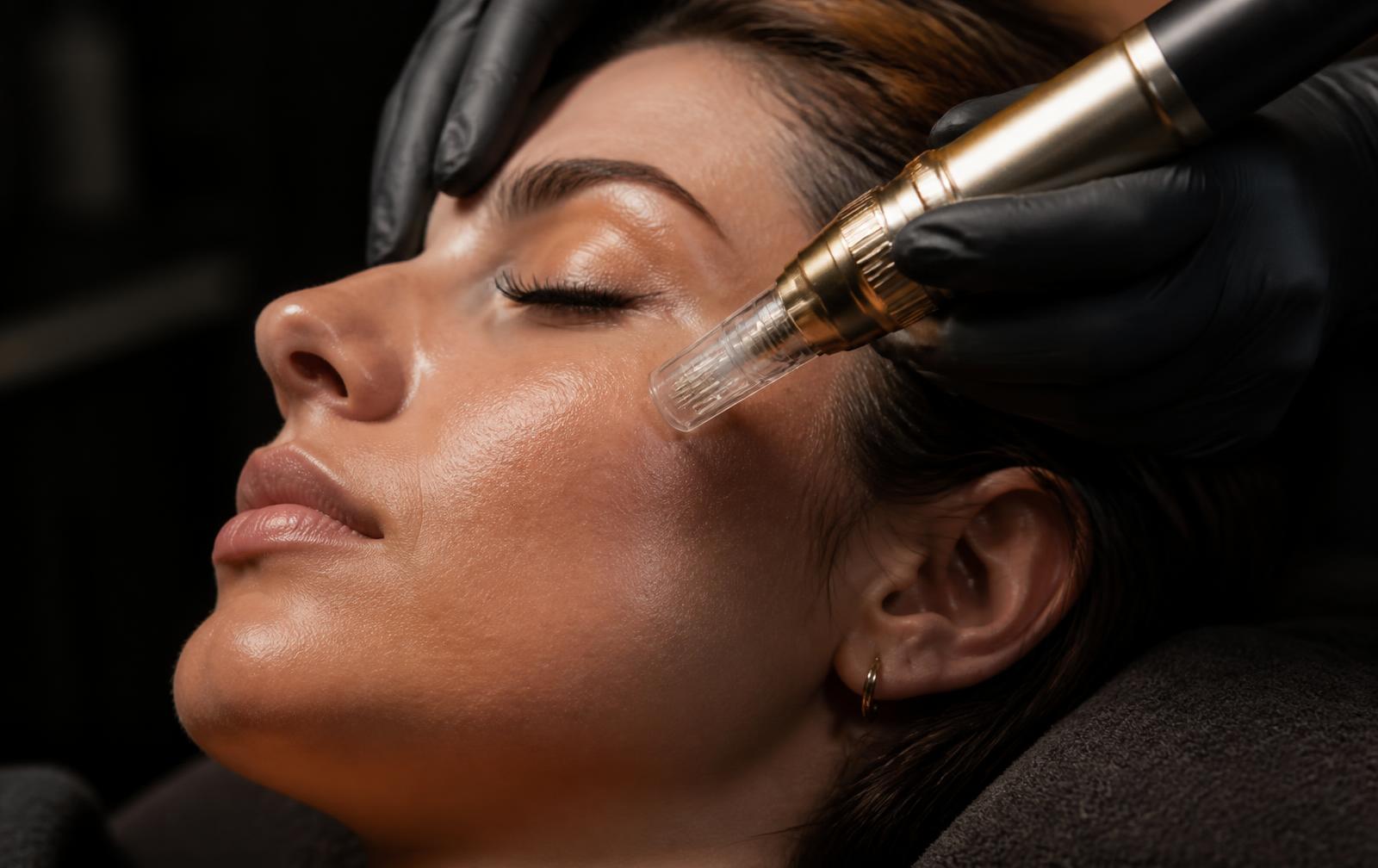
PRP and microneedling get grouped together constantly — partly because they are frequently performed in the same session, and partly because the marketing term 'vampire facial' collapsed them into one idea. They are different treatments doing different work. Understanding which does what is the difference between paying for a meaningful result and paying extra for a step you did not need.
Looking for the treatment itself? See our PRP Therapy in San Antonio — Face & Hair at THEIA page for pricing guidance, protocol details and booking.
What microneedling does
Microneedling creates controlled micro-injuries in the dermis with fine needles at a calibrated depth. The healing response triggers collagen and elastin production over the following weeks. It is the workhorse treatment for acne scarring, enlarged pores, fine lines and overall skin texture.
A typical protocol is three to four sessions spaced four weeks apart, with results building over three to six months. Downtime is one to three days of redness resembling a sunburn.
What PRP does
Platelet-rich plasma is drawn from your own blood, centrifuged to concentrate platelets and growth factors, then either applied topically during microneedling or injected into targeted areas. The growth factors accelerate tissue repair and amplify the collagen response.
On its own, injected PRP is used for volume-poor under-eye hollows, thinning hair at the scalp, and skin-quality improvement. Topically applied PRP without a delivery mechanism does very little — the molecules are too large to penetrate intact skin.
Related at THEIA: Microneedling in San Antonio — Dermapen at THEIA · CO₂ Laser in San Antonio — Pigmentation & Resurfacing at THEIA.
Why they are combined
Microneedling opens temporary micro-channels; PRP applied immediately after reaches the dermis through those channels. That combination measurably improves downtime and outcomes compared to microneedling alone in most published comparisons — faster resolution of redness, and stronger improvement in texture and scarring.
The tradeoff is cost. Microneedling alone in San Antonio typically runs $300 to $500 per session; adding PRP takes a session to $600 to $900 because of the draw, processing and additional time.
How to choose
For general texture, pore size and early fine lines, microneedling alone is usually sufficient and the better value. For moderate to severe acne scarring, PRP is worth the addition — scar remodeling benefits most from the amplified growth-factor response.
For hair thinning, PRP injections are the treatment, not microneedling. For under-eye hollowing and crepiness, injected PRP is the appropriate protocol. For pigmentation specifically, neither is the first-line answer — that is a laser or resurfacing conversation.
Safety and who performs it
Both treatments are delegated medical procedures in Texas and must be performed under medical delegation. PRP adds a phlebotomy step and requires a closed, sterile processing system — ask which system the clinic uses and how the sample is handled.
Neither treatment is appropriate during active acne infection, for patients on certain anticoagulants, or for patients with platelet disorders. A medical intake before the first session is not optional.
Questions
Frequently asked.
Is PRP worth the extra cost over microneedling alone?
For moderate to severe acne scarring and for patients wanting faster healing, generally yes. For routine texture and fine-line maintenance, microneedling alone is usually sufficient.
How many sessions do I need?
Most protocols call for three to four sessions spaced four weeks apart, with maintenance once or twice per year.
How much does a PRP microneedling session cost in San Antonio?
Combined PRP and microneedling commonly runs $600 to $900 per session; microneedling alone typically runs $300 to $500.
Is the 'vampire facial' the same thing?
Yes — it is a marketing name for microneedling with PRP applied during the session. The clinical protocol is what matters, not the name.
Explore
Related treatments.
Continue reading
More from the journal.
Begin with a consultation.
Every treatment at THEIA begins with a medical consultation and good faith examination.